
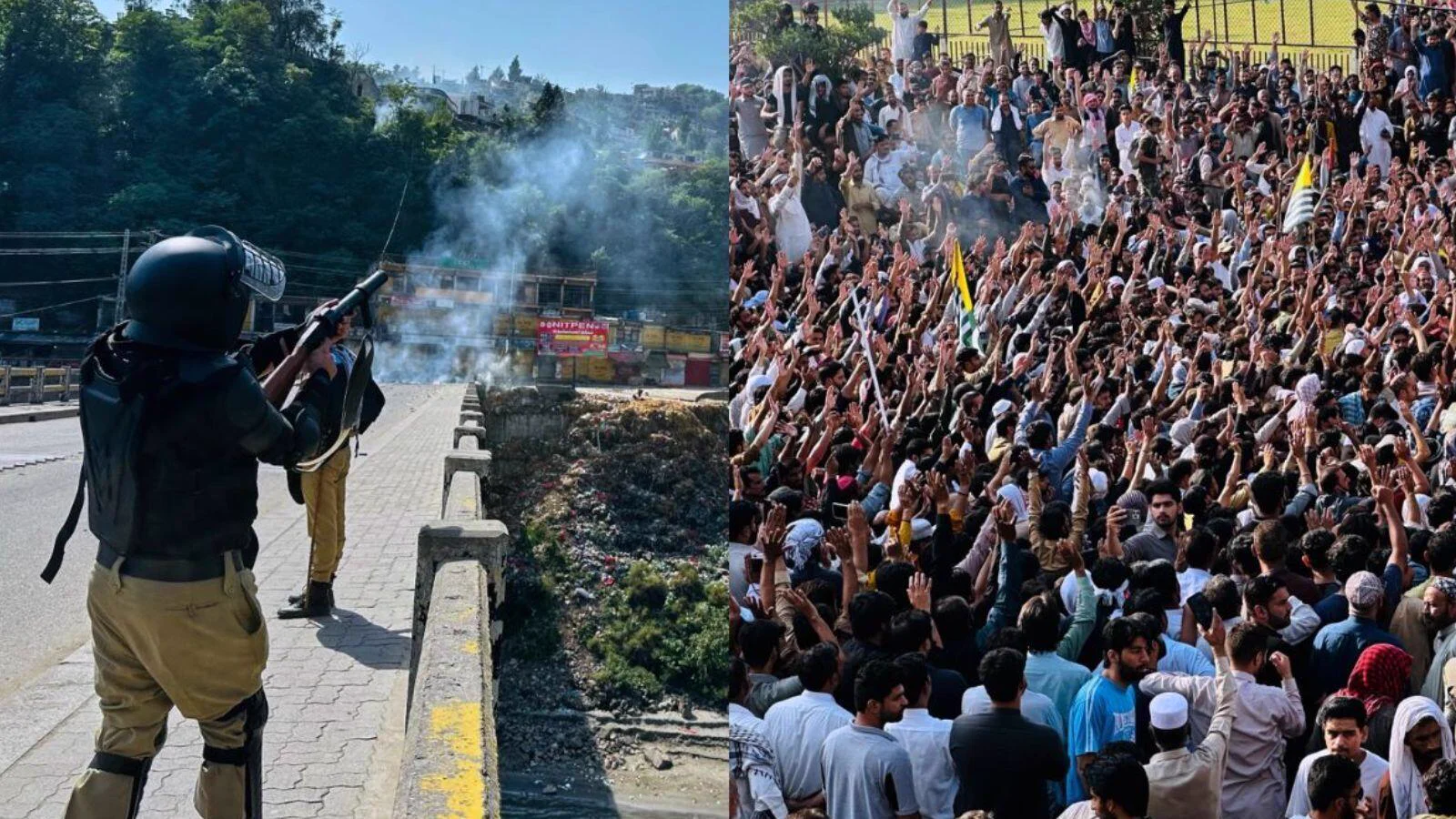
People in Pakistan-occupied Kashmir are protesting against Pakistan with growing frequency, and the discontent is no longer limited to everyday demands. According to an analysis by a professor at the School of International Studies, JNU, the protests have moved from demands for electricity and cheap wheat to a deeper crisis of governance and political representation.
Former Jammu and Kashmir chief minister Farooq Abdullah recently raised the Kashmir issue again, saying the central government cannot help and pointing to Pakistan raising the issue everywhere. The analysis argues the reality is different: Pakistan keeps raising Jammu and Kashmir to hide its own failures, and its own founding idea, in the author's view, was flawed from the start.
The historical argument goes back to 26 October 1947, when Maharaja Hari Singh signed the instrument of accession, making the whole of Jammu and Kashmir, including the present Pakistan-occupied Kashmir, a part of India. The author quotes the Maharaja as saying he was an Indian first, and a Maharaja second.
That history is presented as the backdrop to today's unrest. The question now, the analysis argues, is not only about territory, but about whether people in the regions Pakistan administers feel represented at all.
Separatist voices beyond Kashmir
The discontent is not confined to Pakistan-occupied Kashmir. In Sindh, there is a demand for Sindhudesh, and in Balochistan, a demand for independence. Baloch groups allege that Pakistan's rulers exploit their resources and suppress their identity, and Pakistan has tried to suppress these movements.
Khyber Pakhtunkhwa is also facing worsening conditions. The province struggles with terror groups such as the Tehreek-e-Taliban, and Pashtuns there have long demanded either a united India or an independent Pashtunistan. Pakistan, the analysis says, dismisses these feelings by citing threats to Islam or security.
The historical roots are traced to the early idea of Pakistan itself. In 1930, at a Muslim League session, Mohammad Iqbal spoke of combining Punjab, the North West Frontier Province, Sindh and Balochistan into one state, describing it as the destiny of Muslims in north west India. Kashmir and Bengal, the analysis notes, were not mentioned in that speech.
After Pakistan was formed, the analysis argues, Urdu and Arabic were imposed on Bengali speakers, leading to a long struggle over language and political rights that ended in 1971, when East Pakistan separated to become Bangladesh. That history is presented as a warning about what happens when regional identities are suppressed.
Why the protests in PoK have changed
In Pakistan-occupied Kashmir, the nature of protest has shifted. People are no longer protesting only for electricity and cheap wheat. The cause of their protest has now become a crisis of governance and political representation, according to the analysis.
The Jammu Kashmir Joint Awami Action Committee has played a central role in the movement that began in 2023. A dispute over 12 reserved assembly seats for Kashmiris settled in Pakistan became a flashpoint during the July 2026 elections. The committee alleges that these reserved seats influence the local government, and it demands that they be ended or changed.
The elected government in Pakistan-occupied Kashmir, despite its existence, does not hold power over many important decisions. A 2018 amendment shifted administrative and legislative powers from the local council to Muzaffarabad, but command over those powers still rests with the Pakistan government, the analysis says.
Economic pressures add to the strain. The development budget was cut from 75 billion rupees to 63 billion rupees, and the fuel subsidy budget was also reduced. Unemployment in the region stands at 11 percent, at 23 percent among women and 27 percent among young people. With limited powers and a shrinking budget, jobs and development have become major challenges.
What India is being urged to do
The protests have raised a pointed question: if major decisions are taken in Islamabad, what does local self government in Pakistan-occupied Kashmir actually mean? India has expressed concern over civilian deaths and security force action there, and the analysis notes that at least 90 people have died since June. Some protesters have waved the Indian tricolour and sought help.
These events are presented as recalling the Indian Parliament's resolution of 22 February 1994, which restated India's claim over the areas under Pakistani occupation, including Pakistan-occupied Kashmir and Gilgit-Baltistan. The analysis argues that India should now expose Pakistan's propaganda, so that its political commitment becomes clear.
Whether India acts on that advice is a separate question, and one for policymakers, not commentators. What is clear from the analysis is that discontent across Pakistan's regions is growing, and that the unrest in Pakistan-occupied Kashmir is now framed by its participants as a question of rights and representation, not only of supplies and subsidies.