
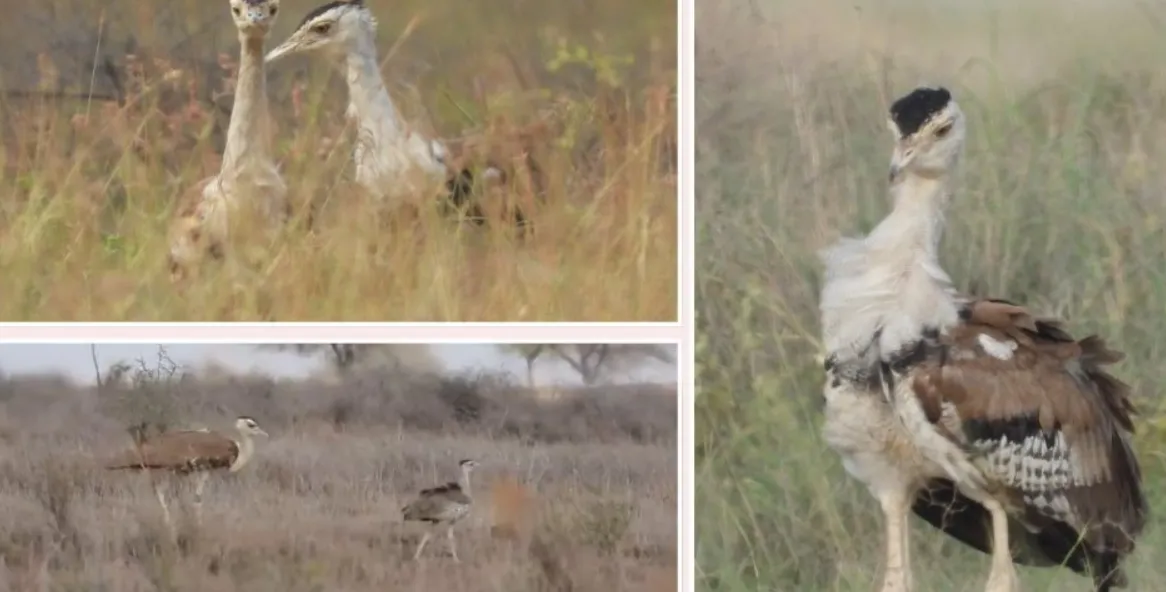
Scientists from the Wildlife Institute of India and the forest department's monitoring team confirmed the chick's sex from its physical traits, after the egg was brought 770 km from Rajasthan under the jumpstart approach.
How the chick's sex was confirmed
The monitoring team and Wildlife Institute of India scientists confirmed the chick is male after studying its physical features. The absence of grey feathers on its head, its darker colour, comparatively thicker neck and distinctive leg structure are all traits of a male Great Indian Bustard, and they are now clearly visible.
The chick was born on 26 March at the Naliya sanctuary in Abdasa, Kutch, and is being watched around the clock by the forest department's field team along with its mother.
The 770 km egg journey
Under the jumpstart approach, a fertilised egg was brought from the breeding centre at Sam in Jaisalmer, Rajasthan, in a special portable incubator, covering 770 km by road in a 19-hour operation involving the forest departments of two states. On 22 March, an infertile egg was removed from the Kutch female's nest and replaced with the fertile egg, which the female then incubated until it hatched on 26 March.
The same method produced a second chick in May, officials said, showing the approach can be repeated.
Why one male matters so much
Since 2020, the sanctuary's only male bustard had disappeared, and the females kept laying eggs that remained infertile for want of a male. About three female bustards currently roam free in the Naliya sanctuary, and the arrival of a male has reopened the path to natural breeding in the wild.
For a species fighting extinction, that single male chick is the difference between a lineage that ends and one that continues.
The longer conservation road
The effort traces back to a vision set out in 2011 and Project GIB, launched in 2016, under which Rajasthan's bustard numbers have risen to 73, and Gujarat is now benefiting from that recovery. The Union forest and environment minister and the state forest minister have praised the joint effort as a decisive step for a vanishing species, and wildlife lovers in Kutch are celebrating the bustard's calls returning to the grasslands after a decade's wait.